Every phone in the “safe phone for kids” category makes the same promise: your child gets a phone, and you get peace of mind. The question that separates them – the one worth five minutes of your attention before you spend anything – is where the safety lives. On most kids’ phones, safety is a layer: an app, a setting, a mode. Layers can be argued with, updated away, or switched off at a weak moment. On Sayph, the safety is the phone. There is no app store, no browser and no social media – not disabled, but absent from the operating system itself. There is nothing to unlock, so there is nothing to nag for.
We’re Sayph, a UK company, and this page is partly about our phone – we’ve marked clearly where we’re describing the category and where we’re describing ourselves.
What actually makes a phone safe for a child?
Four things, in descending order of how often they’re actually delivered:
No open door to the internet. Most harm reaches children through the browser, the app store, and social media – not through calls and texts. A truly safe phone closes those doors rather than putting a childproof cap on them. Settings-based controls (Screen Time, Family Link) leave the doors in place and hope the lock holds; the NSPCC and Internet Matters both document how routinely children work around them.
Contact that you approve. Strangers can’t reach a child whose contacts a parent controls. Every serious kids’ phone does this; a standard smartphone with controls does it weakly.
Location, without surveillance creep. Knowing where your child is, without the phone becoming a tracking device that erodes the trust it was meant to protect.
A design that can’t be renegotiated. This is the one that gets missed. A safe phone that can become an unsafe phone – through an unlocked app store, a removable safety app, or a hundred small “just this once” concessions – is a negotiation, not a boundary. The safest phone is the one where the answer is settled by the hardware, so it never has to be resettled at the kitchen table.
How Sayph does it
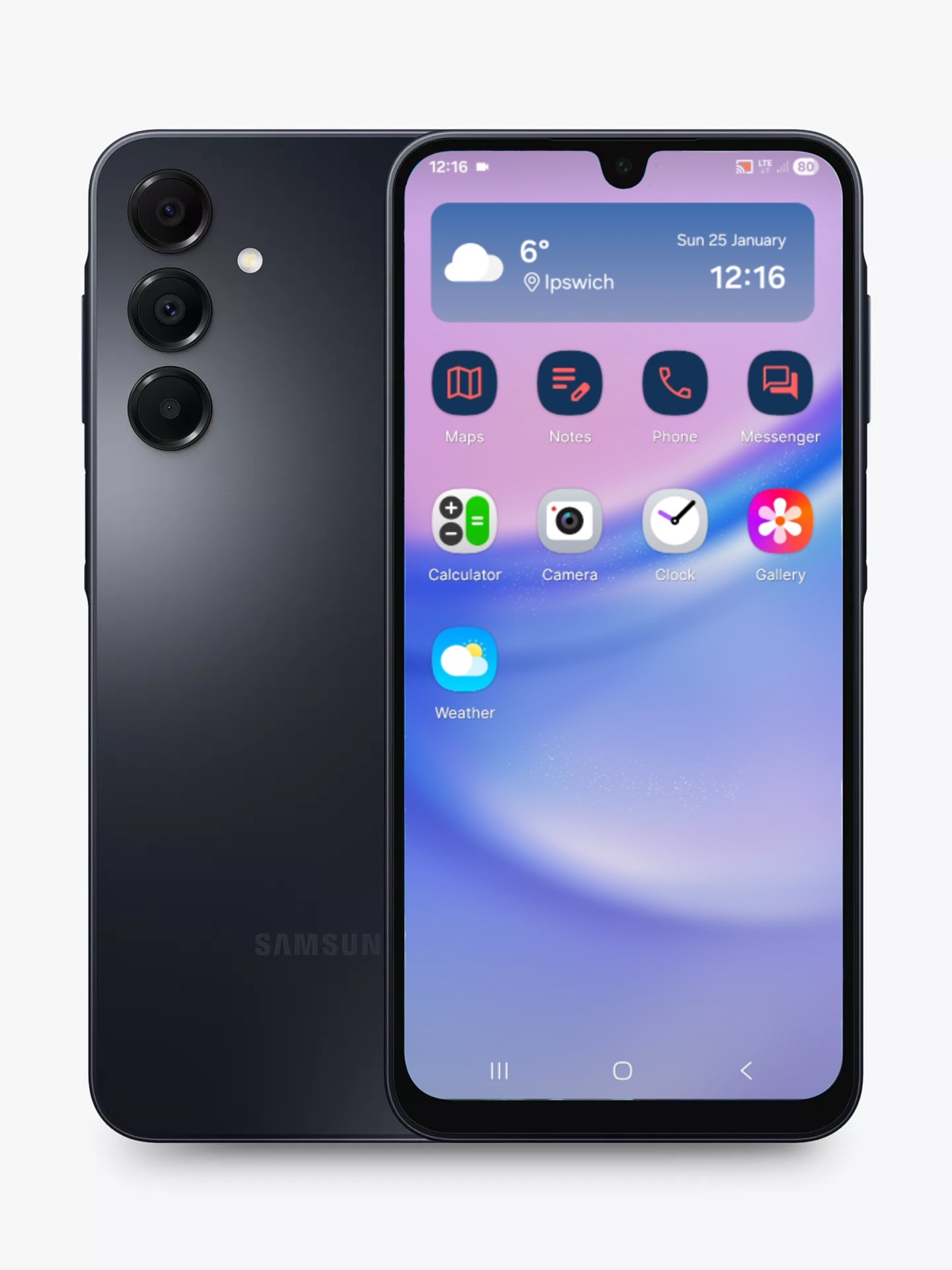
Sayph is a real smartphone – a modified Samsung, the kind of handset a child is happy to be seen with – where the restrictions are built into the operating system. Your child gets calls, messaging, a proper camera, music, maps and the everyday essentials like notes and a calculator. You get the Sayph Space parent portal: approve every contact, see their location when you need to (with arrival and departure alerts), and read every message, grouped by contact, for up to 30 days – with AI-generated summaries on top that flag anything needing your attention, so you stay informed without reading every text. Messages then auto-delete, are never read by our staff, never sold, and never used to train AI. We think children deserve safety and the beginnings of privacy; that balance is the product.
There is no app store on Sayph and no way to add one – not for your child, and not for you. We built it this way because, when our own children reached the first-phone moment, nothing on the shelf held the line we wanted – and because we take the view that the more apps you put on a phone, the more temptation there is to use it. Families tell us this is the feature they didn’t know they were buying: the nagging simply stops.
£189 one-off, £4.99 a month, works with any UK SIM (£2–3 a month from the networks we recommend), free UK delivery, designed and supported in the UK. Gold – Best Child-Friendly Phone, MadeForMums Tech Awards 2026. And for every ten phones bought by a school community, we donate one to a pupil-premium child. See how Sayph works.
The limits, plainly
No phone is right for every family, ours included – and we’d rather say so plainly than discover you found out after buying. Sayph has no WhatsApp – at twelve and under we’d argue that’s a feature, but if your child’s social world already runs on it, read our WhatsApp guide before buying anything, including from us. And if what you actually want is a phone that grows into a full smartphone with training wheels that come off gradually, that’s a legitimate philosophy – it just isn’t ours, and Pinwheel or the HMD Fuse will suit you better.
The safe phone options in the UK, side by side
| Approach | Examples | Typical cost | The catch |
|---|---|---|---|
| Safe by design (no app store, ever) | Sayph | £189 + £4.99/mo | No WhatsApp; not a growth-path phone |
| Curated apps, growing access | Pinwheel, HMD Fuse | £189–£498 + up to £15.99/mo | The negotiation never quite ends |
| Standard phone + parental controls | iPhone + Screen Time, Android + Family Link | from ~£100 refurb | Settings get bypassed and eroded |
| Monitoring-first | Wingio | from £149 + £7.99/mo | Full surveillance; heavier trust cost |
| No smartphone at all | Nokia brick, Xplora watch | £20–£170 | Social cost rises sharply from ~11 |
Our complete UK guide to phones for kids walks through every row of this table without the sales hat on, and our age guides (10–11 · 12 and secondary school) match the choice to your child’s stage.
Frequently asked questions
What is the safest phone for a child in the UK?
The safest phone is one where the protections can’t be removed – by the child, or by wearing the parent down. That means restrictions built into the operating system (Sayph’s approach) rather than an app or setting that can be bypassed or uninstalled. From there, “safest” depends on your child: a watch for under-8s, safe-by-design for 8–13, managed smartphones for teens.
Can my child bypass Sayph’s restrictions?
No. There is no app store, browser or social media in the operating system to unlock – a factory reset produces the same phone. This is the difference between safety as design and safety as settings.
Does a safe phone need a special SIM?
No. Sayph works with any UK network; a £2–3/month SIM from Smarty or giffgaff covers a child’s typical use. Some families add a network-level filter like ParentShield for call/text oversight on any phone – useful, but it can’t control apps, which is why it complements rather than replaces a safe handset.
Is an iPhone with Screen Time safe enough?
It’s better than nothing and less than it appears – passcodes get observed, settings get renegotiated, and workarounds are a search away. We’ve written a side-by-side comparison of the Screen Time route, including when it is the right answer.
What age is Sayph for?
Designed for 8–16. In practice most Sayph children are 8–13 – the years where holding a simpler line matters most. What age should a child get a phone? covers the timing question properly.
Sayph – phones for kids, safe by design. £189 with free UK delivery, £4.99/month, any UK SIM. Order today or see how it works.